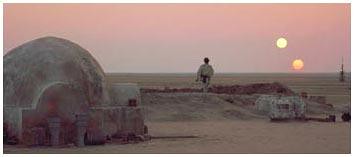
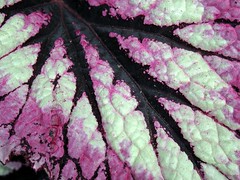
 Research at the California Institute of Technology's Virtual Planet Laboratory suggests that if plant life exists on other planets the dominant color of photosynthesis could be yellow, orange, or even red instead of the usual green. The particular color would depend on the type of star(s) the planet which has plant life orbits and the planet's atmosphere, which filters the light. For example there is a bacteria on earth that uses infra-red light in photosynthesis because it lives in murky water where little to no visible light reaches.
This is good news for science fiction, where plant life has often been unimaginative, though H.G. Wells' depiction of red plant life in The War of the Worlds in 1898 is an important exception. Other sci-fi ecosystems of note include Harry Harrison's psychic plants in Deathworld and Alan Dean Foster's silicon based life in Sentenced to Prism.
Press release.